
Location
Des Moines, Iowa
Year
2025
Size
46,816 SF
Client
Tim Rypma
Project Team
David Gosnell
Tim Hickman
Jeff Wagner
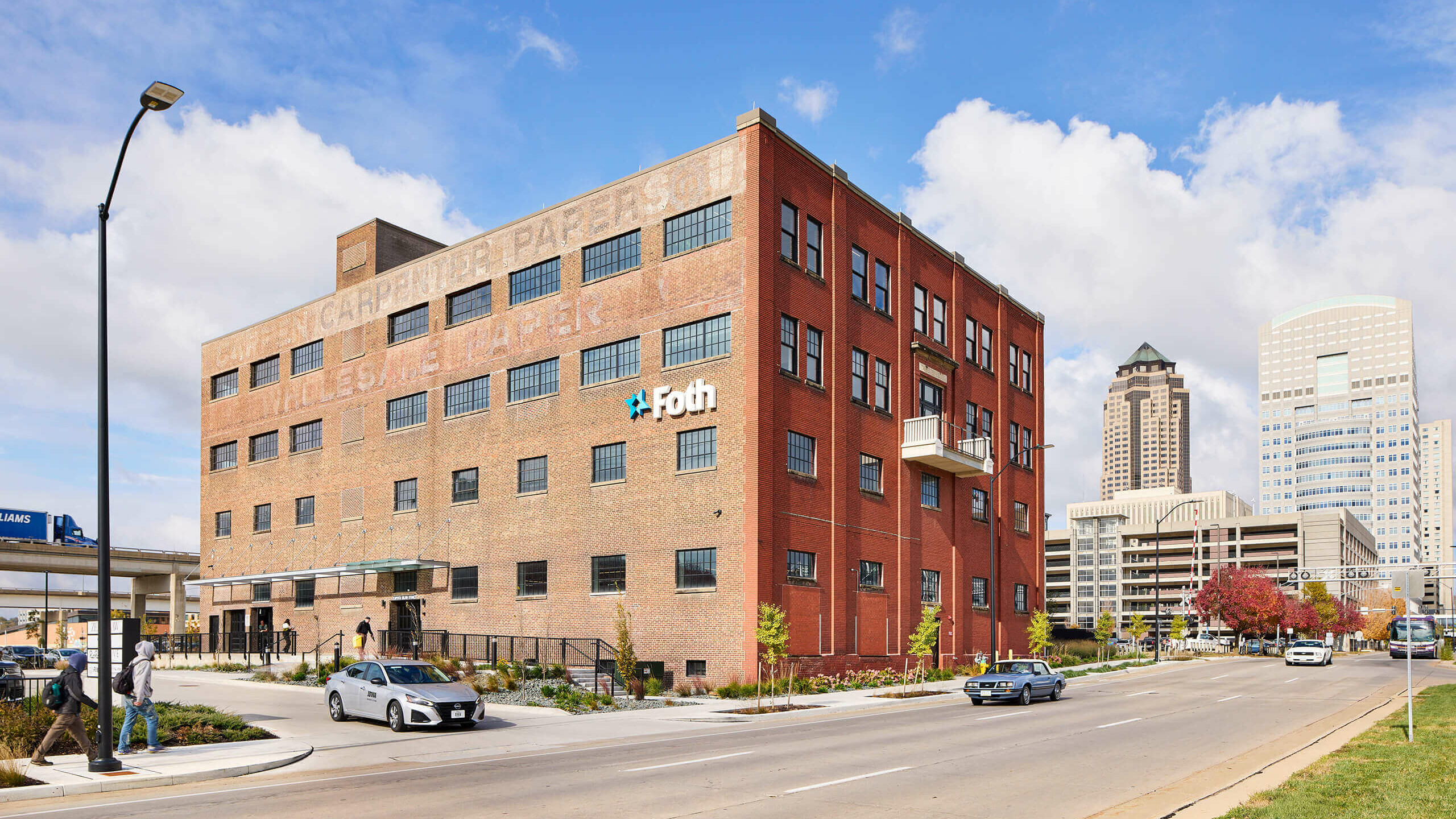
When one of the last undeveloped heavy-timber brick warehouses which used to define the southern edge of downtown Des Moines went on the market, a local developer and past client purchased this piece of history.
Originally constructed in 1918 for the Carpenter Paper Company, the wholesale paper company whose name can still be seen across the top of the building, the building was later sold to an insurance company who used the space for document storage. Defining characteristics of the building include its exposed heavy timber and masonry structure and large steel warehouse windows.
Our client engaged us to assist in the adaptive reuse of this four-story warehouse building to a multi-tenant office building. The project included restoring and tuckpointing the original brick exterior; exposing closed-off windows and removing corrugated steel paneling on the north facade; restoring historic steel windows where they existed and providing window replacements consistent with the original. New windows were also installed on the north elevation into new openings, added because that side of the building had originally been shared by an adjacent building. Inside, the heavy timber beams remain exposed.
Necessary infrastructure—egress stairs, restrooms, raised access floor, concealed mechanical and electrical systems—to allow a former warehouse to function as a modern-day office building were added. The building will soon house four new tenants.


Because the building’s use was previously industrial, the windows were set high on the walls which created a significant obstacle in converting the space for residential or commercial use. To address both historical preservation and modern functionality, the team raised the building’s floors by two feet. This innovative solution allowed the high-set industrial windows to remain intact while effectively lowering their relative position. The raised floors also served a dual purpose by concealing all mechanical systems—electrical wiring, plumbing, ductwork, sprinklers, and telecommunications—within the space beneath, leaving the original wood ceilings and beams visually uncluttered. This approach preserved the building's character while achieving modern code compliance, such as fire ratings between floors.


Since the building originally had no windows on the north side—due to a now-demolished adjoining structure—new windows had to be installed to match the historic design. Additionally, to comply with fire codes, a new stair tower was constructed in the center of the building, providing a second means of egress from the basement to the roof. This structural addition was complex, requiring careful work to modify a century-old building. However, it also served a practical purpose: the stair tower became the support for a new rooftop heating and cooling system, integrating safety and infrastructure needs into a single architectural feature.

A defining feature of the building is its historic relationship to the former Seventh Street Viaduct. Originally constructed alongside the viaduct, the warehouse accommodated vehicular and pedestrian access directly to its third floor, spanning the rail yard and connecting downtown Des Moines to surrounding south-side neighborhoods. When the viaduct was removed in the late 1990s, the former entry was left suspended, creating a distinctive “floating entrance” that remains a physical marker of the city’s evolving infrastructure. The renovation preserves this moment in time through the introduction of a new balcony, thoughtfully referencing the building’s original connection to the viaduct.


Structural Engineer
KPFF
Civil Engineer
Civil Engineering Consultants, Inc.
Landscape Architect
Genus Landscape Architects
MEPT Engineer
Design Engineers
Preservation Consultant
AKAY Consulting
General Contractor
Hildreth Construction Services
Substance Architecture
David Gosnell, Tim Hickman, Jeff Wagner, Justin Burnham, Charvi Jagani
Carpenter Paper Building Recognized with Historic Preservation Project of the Year Award
The 'new' Carpenter Building Featured in Des Moines Business Record
Photography by Corey Gaffer (exteriors) and Chris Boeke Studio (interiors)


